

The parallel audit on Artificial Intelligence, conducted under the leadership of SAI Israel in cooperation with 11 European countries, was presented during the conference. The event was headed by EUROSAI President Mr. Matanyahu Englman (SAI Israel) and attended by Heads of SAIs and experts from over 20 countries
An International Conference on “AI in State Audit” was held in Abu Dhabi on 2-3 February 2026, bringing together Heads of Supreme Audit Institutions (SAIs) and experts from more than 20 countries to examine the opportunities, risks, and challenges posed by artificial intelligence in public-sector auditing.
The conference was headed by the President of EUROSAI and State Comptroller of Israel, Mr. Matanyahu Englman, and hosted by the President of the UAE Accountability Authority, H.E. Humaid Obaid Abushibs .
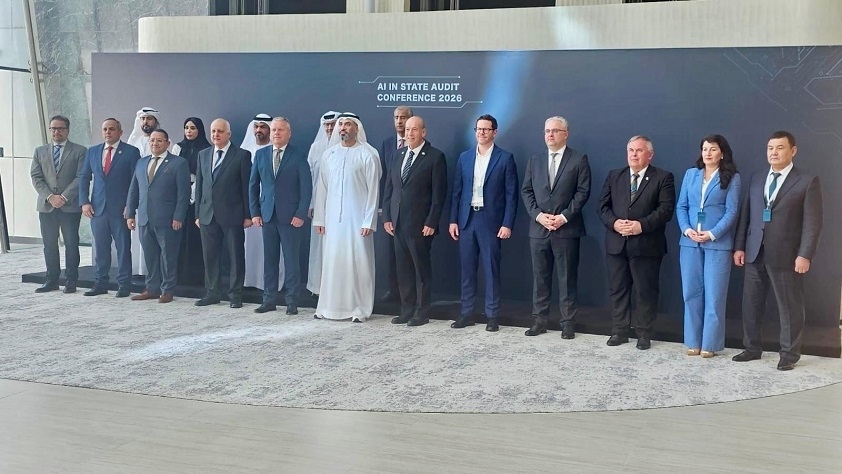
Participants of the International Conference
Mr. Englman expressed his sincere appreciation to the Heads of SAIs and distinguished participants for their active engagement, and extended his gratitude to the UAE Accountability Authority for its leadership and foresight in recognizing the growing relevance of artificial intelligence, with the United Arab Emirates assuming a leading role in this field.
A central highlight of the conference was the presentation of the parallel audit on artificial intelligence, conducted under the leadership of SAI Israel in cooperation with the Supreme Audit Institutions of Albania, Estonia, France, Italy, Latvia, Lithuania, North Macedonia, Poland, Romania, Slovakia, and Switzerland.
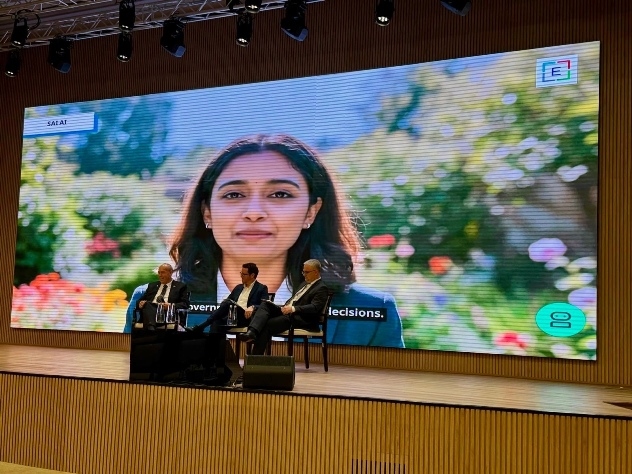
The Q&A panel discussion featuring the AI-Based avatar auditor
An insightful Q&A panel discussion, moderated by the EUROSAI President, featured the President of the Swiss Federal Audit Office, Mr. Pascal Stirnimann, and the Auditor General of the National Audit Office of Estonia, Mr. Janar Holm, who exchanged views on the evolving role of state audit in the era of artificial intelligence. The panel was further joined by an AI-based avatar auditor from SAI - AI, which also presented professional insights in response to each of the questions discussed, offering an innovative perspective on the potential role of artificial intelligence in state audit.
In addition, Mr. Englman interviewed the Secretary-General of the OECD, Mr. Mathias Cormann, focusing on the approaches adopted by governments and Supreme Audit Institutions worldwide in responding to the challenges of artificial intelligence.
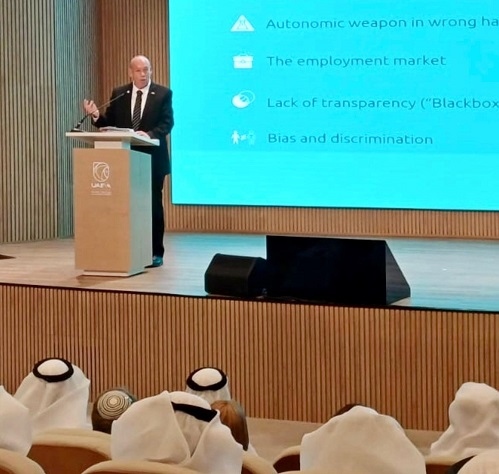
Mr. Englman keynote presentation at the conference
The conference included a series of expert presentations addressing both strategic and practical aspects of AI. Dr. Sterling Thomas, Chief Scientist of the U.S. Government Accountability Office, presented emerging trends and key challenges posed by artificial intelligence. Mr. Jorg Petrovič of the European Court of Auditors reflected on the European Union’s ambitions in the field of AI. Mr. Emmanuel Marcovitch, Senior Auditor at the French Cour des Comptes, shared insights on developing audit methodologies for artificial intelligence in the public sector. Mr. Alvar Nõukas, Project Manager for Data Analytics at the National Audit Office of Estonia, discussed practical ways in which AI can be utilized in auditing, while Ms. Ruth Kelly, Chief Analyst at the UK National Audit Office, addressed how auditors can contribute to strengthening public trust in AI.
External experts also contributed to the discussions, including Prof. Yoav Shoham, Co-founder and CEO of AI21 Labs, and Mr. Akshay Dalal from Google’s Dubai office. The topic of professional capacity-building was further addressed by Mr. Chris Dimitriadis, Chief Global Strategy Officer of ISACA, and Mr. Asaf Weisberg, Director on the ISACA Board of Directors, who presented “The First Advanced Audit - Specific AI Certification.”
Q&A on AI in State Audit
Summarizing the significance of the conference, Mr. Englman stated:
“Artificial intelligence is not merely another stage in digital innovation. It is a general-purpose technology with far-reaching implications for productivity, labor markets, public services, competition, and governance itself. As AI becomes increasingly embedded in public administration and decision-making, the role of Supreme Audit Institutions will be pivotal in ensuring that innovation remains aligned with legality, efficiency, and transparency. Effective international cooperation in this field is therefore essential.”