

A delegation from the State Comptroller and Ombudsman's Office, led by Director General Brigadier General (Res.) Yishai Vaknin, conducted a visit to the communities within the Sha'ar HaNegev Regional Council and Netivot, to garner insights regarding the rehabilitation efforts as well as the ongoing challenges faced by the residents
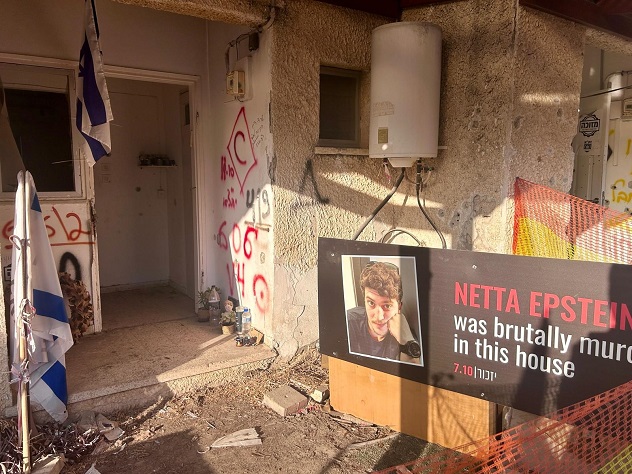
In the youth's neighborhood of Kibbutz Kfar Aza, time seems to have stood still. The small apartments, which until recently resonated with laughter and music, stand in ruins, serving as a silent memorial to the massacre that claimed the lives of 62 kibbutz members, along with 18 soldiers and ISA personnel. Warning inscriptions, spray-painted on the doorways by the first responders who arrived at the scene, linger: "Acquitted... Blood remains at the entrance to the protected area and throughout the living room", "Human remains on the sofa".
Within the modest apartment of the late Sivan Elkabetz and Naor Hasidim, the aftermath of the atrocities committed by Hamas perpetrators resonates vividly. The ceiling, walls, refrigerator, and washing machine – all bear the scars of numerous bullets that penetrated every corner.
On the wall, the bereaved parents have affixed an enlarged photograph of WhatsApp messages from "sweet Sivani" dated October 7, serving as a poignant reminder of her final moments:
11:11 - "They were at my window; we were under the bed, me and Naor. Is everyone okay, Dad?"
11:11 - "We're fine... Send me your location"
11:16 - "Are there soldiers in your neighborhood?"
12:21 - "Sivani"
22:40 - "Sivani"
A short distance away, construction efforts are underway for a new neighborhood – the "Green Floors" neighborhood, whose residences have been renovated and donated by volunteers. The distance between the devastated and the newly constructed neighborhoods may be small, but the contrast resonates profoundly throughout the tour. This is the distance between destruction and revival, between mourning and hope, and the nascent signs of renewal, the buds of which can already be discerned in the settlements of the Gaza Envelope.
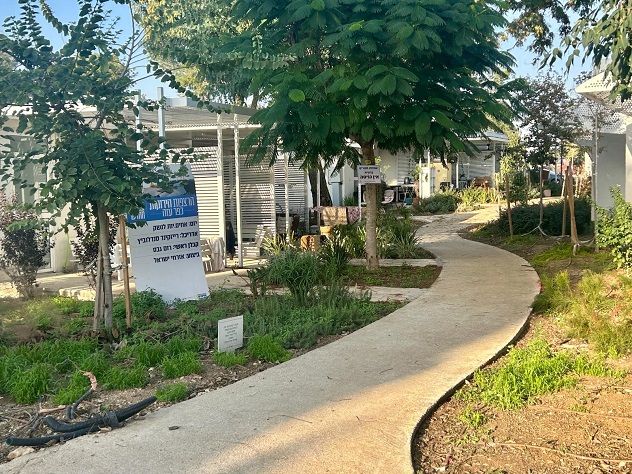
The Green Floors neighborhood in Kfar Aza
"We Must Not Lose the Next Generation of the Kibbutz"
These days, Brigadier General (Res.) Yishai Vaknin, alongside senior officials from the Office, is undertaking a series of nationwide tours to closely assess the gaps identified in previous evaluations conducted during the Swords of Iron War and Operation Rising Lion.
The tour of the Sha'ar HaNegev Regional Council localities and the city of Netivot, conducted on November 18, 2025, included participation from the Director of the Ombudsman Office, Carmit Fenton, and the Director of the Administration and Human Capital Division, Amir Ganor. Senior representatives from the Office, engaged in the audit and inquiry of complaints from localities in the western Negev in the context of the war, were also present.
On the eve of the war, Kfar Aza was home to 950 residents. Two years later, a substantial majority have yet to return to the kibbutz. The wounds remain open. "The terrorists infiltrated every corner here; nearly 400 houses require renovation", the kibbutz representatives assert.
The Tkuma Directorate has set the summer of 2026 as a target date for the return of the residents; however, the kibbutz considers this projection overly optimistic: "It will be a formidable challenge to bring back our people. Young families, particularly those with children, are the most reluctant, and they represent the next generation of Kfar Aza; we must not lose them".
To this end, they emphasize the necessity for significant state assistance: "Yet, even now, two years later, we continue to encounter difficulties in obtaining the support we require. We expect the state to extend a generous response, recognizing that we are on the front lines and not quibble over every expenditure".
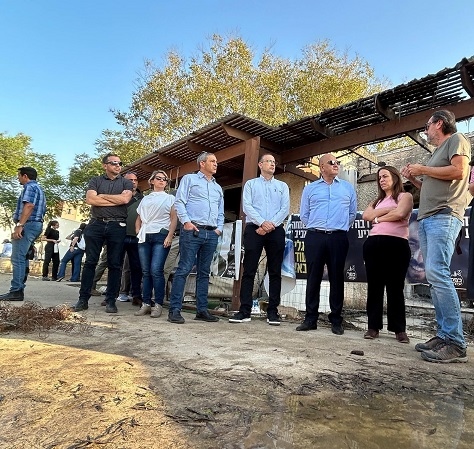
The delegation from the State Comptroller and Ombudsman's Office in the Youth's Neighborhood in Kfar Aza
"The Residents Need Conductive Conditions and Security"
Located 750 meters from the western boundary of Kibbutz Nahal Oz, lies the devastated Shuja'iyya Quarter. It was from here that a multitude of terrorists launched an assault on October 7, infiltrating the kibbutz in three waves. "The fields you observe here were inundated with terrorists", explained the commander of the rapid response unit, Barry Meirowitz. "Two years later, we remain the most divided community among all communities".
To date, approximately half of the kibbutz's 450 residents have returned, following a two-year period during which they resided in Mishmar Ha'Emek and other locales across the nation: "While the kibbutz stood vacant, we undertook renovations of all houses, infrastructure, and public buildings – despite many remaining structurally intact, to ensure a more favorable environment for residents upon their return".
The refurbished houses gleam in their whiteness; however, the current reality is far from idyllic: "Since the conclusion of the war, we have witnessed an increasing return of families, yet they require both conducive conditions and security. We have resumed operations as an agricultural kibbutz but face numerous constraints".
Near the fence of Kibbutz Nahal Oz, in front of the ruins of Shuja'iyya Quarter
Kfar Aza and Nahal Oz are among twelve localities within the Sha'ar HaNegev Regional Council, which previously housed approximately 10,000 residents. "Over the past two years, we have encountered significant challenges", remarked the Council's Director General, Uri Pinto. "There remains a crisis of trust among residents concerning the military, a persistent trauma they are grappling with, when the dispersion of communities over the past two years presents additional challenges".
"The rehabilitation of Sha'ar HaNegev is anchored in four pillars: the educational system, economic development, security and protection, and community. Community transcends geographical boundaries; the hostages and their families constitute a community, as do the bereaved families", Pinto observed.
"We have returned here to assess the situation after two years", stated the Office Director General. "The State Comptroller is set to release an important report on the rehabilitation of the population in the western Negev communities, and the Ombudsman within our Office continues to be accessible to assist residents with their bureaucratic interactions with public agencies. We extend our support in confronting the numerous challenges ahead".
The Hope of Netivot
The signs of rehabilitation are particularly pronounced in Netivot. The skyline is dominated by the construction of apartment towers in new neighborhoods. Even Mayor Yechiel Zohar finds it challenging to articulate the unexpected growth of this southern city – growth that has persisted even amidst ongoing conflicts in the adjacent Gaza Strip. Advance preparations and a prompt response from the municipal security unit, OFEK, on October 7 successfully thwarted an incursion by the Nukhba Force that was en-route to the city.
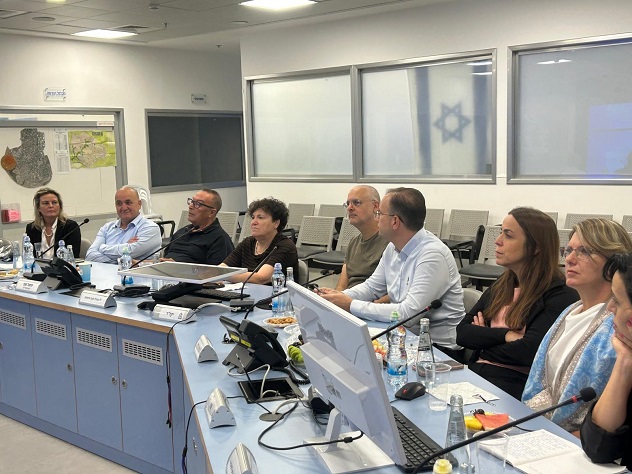
With the Mayor of Netivot at the Municipal Operations Center
Netivot is home to approximately 60,000 residents, one-third of whom are newcomers to the city. The demographic is notably youthful, with around 60% of the population being forty years of age or younger; this group includes approximately 23,000 children and teenagers. The accelerated growth necessitates substantial preparatory measures, as new educational institutions are established annually. Additionally, Mayor Zohar has announced plans to develop a regional hospital within the city – however, he acknowledges challenges in securing government funding, compelling the municipality to depend on donations: "We received more from world Jewry than from the government".
The Director General commended the actions of the OFEK security unit, remarking that "the ability to transition from routine to emergency in an instant is impressive and awe-inspiring". He further noted that "the increase in population and the construction of new neighborhoods serve as a response to our enemies – there is no greater victory than that".