

EUROSAI President, Mr. Matanyahu Englman (SAI Israel): "The future of state audit belongs to the empowered auditor who masters AI capabilities without ever surrendering their mandate for professional skepticism and absolute truth"
EUROSAI President and the State Comptroller and Ombudsman of Israel, Mr. Matanyahu Englman, presented a pioneering vision for the future of state auditing this week at the annual OECD meeting for Auditors-General.
Speaking to a global audience of his peers, Mr. Englman detailed how the State Audit Office of Israel (SAI Israel) is leveraging artificial intelligence to enhance the efficiency, relevance, and impact of its work.
The presentation took place during the conference's third session on Thursday, May 28th, titled "The Implications of AI on Audit." Mr. Englman shared the stage with Ms. Dolores Genaro Moya, President of the Audit Section of Spain's Court of Audit, and Mr. Vital Do Rêgo Filho, President of Brazil's Federal Court of Account
In his address, "The Implications of AI on State Audit: Combining Innovation WithCredibility," Mr. Englman unveiled a comprehensive AI-driven workflow. This model transforms the traditional four-phase audit process - Planning, Conducting, Reporting, and Follow-Up - by embedding advanced AI tools such as Machine Learning, Large Language Models (LLMs), and Computer Vision at every stage.
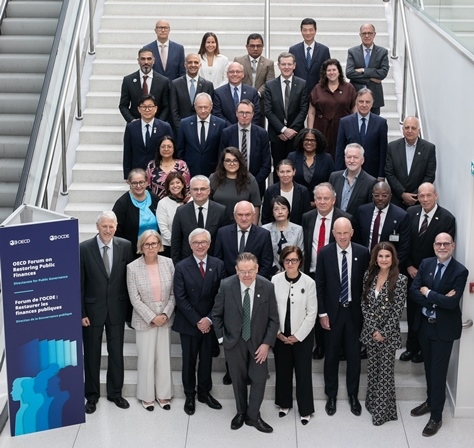
The Participants at the OECD Conference in Paris
To illustrate the practical application of this approach, the presentation featured a compelling case study on tackling the high cost of living in Israel. By applying an AI prompt engine to the OECD's own 2025 Economic Survey of Israel, the Comptroller's Office was rapidly able to identify three critical areas for a state audit: public infrastructure, educational outcomes, and market competition.
Diving deeper into market competition, the AI-assisted audit uncovered significant structural issues. It identified a "Big Three" dominance, where top suppliers control 85% of the market share in 20 distinct food categories. Furthermore, AI-powered big data analysis detected glaring statistical anomalies, such as a 150% price deviation in Israeli food and non-alcoholic beverages compared to the EU baseline.
The audit's output was not just data but a set of clear, actionable policy directives, including adopting EU standards for imports ("What's Good for Europe is Good for Israel"), aggressive anti-monopoly action, and the elimination of certain tariffs to reduce consumer prices.
"Innovation is not a luxury but a necessity for modern state audit", he stated. "As auditors, our credibility rests on our ability to provide timely, relevant, and impactful insights. Through the collaborative efforts of EUROSAI and the dedicated work of my team at SAI Israel, we are actively embedding advanced technologies to cut through complexity and deliver the truth. The future of state audit does not belong to artificial intelligence alone; it belongs to the empowered auditor who masters AI capabilities without ever surrendering their mandate for professional skepticism and absolute truth".
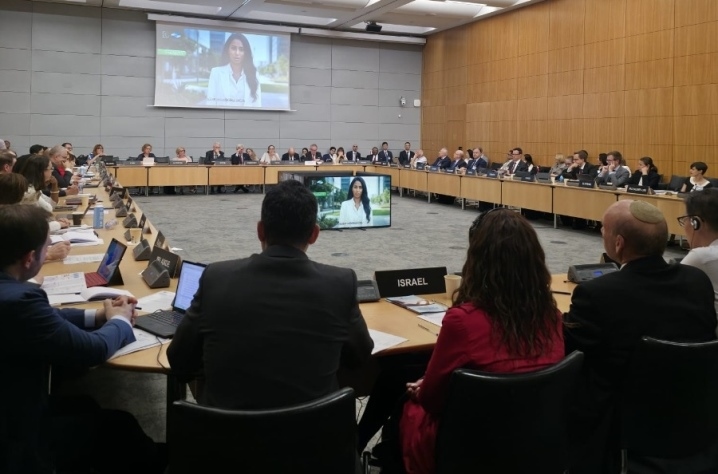
Participants at the OECD Conference viewed a video showcasing the Parallel Audit on AI, coordinated by SAI Israel
While championing the opportunities of AI - from predictive risk assessment to real-time anomaly detection - he also warned of the "Dual Horizon" of risks. He highlighted the "Black Box Problem," where the inability to trace an AI's conclusions could undermine an audit's legal defensibility, and stressed the dangers of data sovereignty violations and the potential erosion of public trust.
The EUROSAI President also reviewed the findings of the ground-breaking Parallel Audit on AI, which was published in March 2026.
The audit examined governmental preparedness for the implementation of artificial intelligence across 12 participating Supreme Audit Institutions (SAIs): Albania, Estonia, France, Israel, Italy, Latvia, Lithuania, North Macedonia, Poland, Romania, Slovakia, and Switzerland. The report provides a comparative perspective on how governments are addressing the legal, ethical, and operational challenges arising from the growing use of AI technologies.
This initiative was coordinated by SAI Israel, which led the parallel audit process through all its stages in close cooperation with the participating SAIs. The project reflects a high level of professional collaboration and knowledge-sharing within the EUROSAI community.