

State Comptroller and Ombudsman Matanyahu Englman, before the Knesset State Control Committee: "The core reports were delayed for over a year due to an interim injunction by the High Court of Justice"
State Comptroller and Ombudsman Matanyahu Englman appeared today (May 12, 2025) before the Knesset State Control Committee, where he presented to the Members of Knesset the progress made in the audit of the failures of October 7 and the Swords of Iron War.
Englman revealed to committee members that work has been completed on 19 audit reports, covering all levels — political, military, and civilian — and that drafts of these reports have been sent to the relevant audited entities across all three levels for their response.
“From the very beginning, we acted with urgency to carry out a comprehensive audit of all the relevant bodies,” the State Comptroller said during the discussion. “By now, the core reports should have already been published – reports that would have provided answers to the Israeli public about the failures that led to the Simchat Torah massacre on October 7. While an interim injunction from the High Court prevented audits of the IDF and the Shin Bet, we used that time to prepare the groundwork, so that we would be ready to carry out the audits as soon as approval was granted. Now that the framework agreed upon with the IDF and Shin Bet has been given the force of a court ruling, we are proceeding accordingly.”
“In the meantime,” he added, “we have already published five civilian reports related to the war, such as on the response to mental health needs following the events of October 7, 2023, and the Swords of Iron War. In addition, I can inform you that we have recently completed work on 19 different topics, and the draft reports have been distributed to the audited parties at all levels – political, military, and civilian. Once we receive the responses — and where necessary, hold hearings in cases involving personal responsibility — we will publish the final reports to the public.”
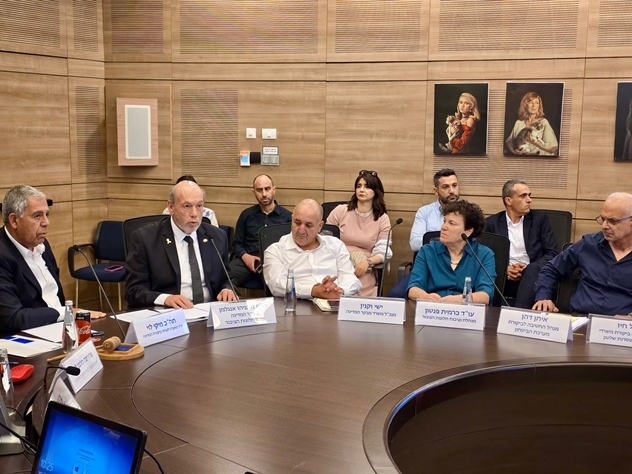
Session of the Knesset State Control Committee
The reports cover the following topics:
- Evacuation and absorption of civilians during the Swords of Iron War
- Government response to northern communities
- Functioning of the Socio-Economic Cabinet
- The absence of a national security doctrine and its impact on decision-making processes at the political and military levels
- Government management of the civilian sector during the Swords of Iron War
- Implementation of economic assistance to small businesses in the early weeks of the war
- Economic emergency preparedness prior to the Swords of Iron War
- Preparation of the war budgets for 2023–2024 by the Ministry of Finance
- Execution of the war budget at the onset of the conflict
- Payment of compensation to reservists
- The role and employment framework of community security coordinators (Ravshatzim)
- Effectiveness of the separation barrier (seam line) around Jerusalem
- Ensuring emergency food supply
- The agricultural sector during the Swords of Iron War
- Promoting tourism in Eilat in the context of the war
- Government public diplomacy in the battle for international public opinion
- Protective measures and shelter infrastructure in local authorities
- National cyber preparedness and performance during the Swords of Iron War
- National-level digital systems for coordination and the management of displaced persons
The Comptroller noted that additional reports are currently undergoing final revisions. These include the report on the licensing and security arrangements for the Nova Music Festival at Re’im, the report on the defense of Sderot and Ofakim, and the report on the evacuation of the wounded and the fallen.
“I would stress that these are not yet the core reports,” the Comptroller concluded. “Those have been delayed for over a year due to the interim injunction and will be published once work on them is complete.”