

Kiryat Shmona is struggling to recover from the damage of the war (“We’ve gone back 20 years”); in Metula not all services have yet been restored (“Volunteers are distributing mail”); and business owners are struggling to make ends meet (“I don’t see the light at the end of the tunnel”). A delegation from the Office of the State Comptroller and Ombudsman conducted a field visit
The Upper Galilee is especially beautiful at this time of year. Winter rains have painted the mountains green, and cows are once again grazing among the orchards. Tranquility. However, the sense that everything has returned to normal after such a prolonged war is misleading.
Although the fighting in the north ended some time ago, the Upper Galilee is still fighting – this time to recover from nearly two years of evacuation and destruction.
“I say this with sorrow,” sighed Kiryat Shmona Mayor Avihai Stern, “but the enemy has succeeded in its mission to thin out the population in the country’s northern periphery.” Indeed, the data presented by the mayor of Kiryat Shmona to the delegation from the Office of the State Comptroller and Ombudsman—which visited the city on January 28, 2026, led by Director General Yishai Vaknin—were grim.
In October 2023, on the eve of the Swords of Iron war, approximately 25,000 residents lived in Kiryat Shmona. Today, after nearly two years of evacuation, only about 15,000 have returned to their homes. “Kiryat Shmona has gone back 20 years,” Stern said painfully.
The number of students in the city has dropped from 4,700 before the war to approximately 3,700 today. “We opened kindergartens with eight or ten children because there were not enough registrants,” the mayor testified.
In one figure, there has been an increase, but not a positive one: the number of welfare recipients in Kiryat Shmona has more than doubled since October 7, rising from 1,720 to 3,600. “In the past, Kiryat Shmona had a maternity ward and a front-line emergency room. Now it has neither,” Stern said. “The population of the Upper Galilee has grown—while we have moved backward.”
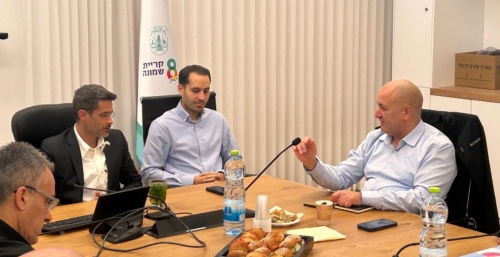
The Mayor of Kiryat Shmona with a delegation from the Office of the State Comptroller and Ombudsman
Oversight and the Ombudsman in the Field
With the outbreak of the Swords of Iron war, the State Comptroller and Ombudsman, Matanyahu Englman, together with staff from his office, conducted dozens of field visits—from Metula to Elat—to closely monitor gaps and deficiencies in the treatment of the population. These visits effectively launched the comprehensive audit our office is conducting of the political, military, and civilian leadership following the events of October 7 and the Swords of Iron war. To date, the Comptroller has published around 30 of approximately 50 audit reports on the functioning of the various bodies during the war.
Alongside the audit work, the Ombudsman’s Office established service stations in northern and southern communities, evacuee hotels, and military reserve centers to help the public navigate bureaucratic hurdles in dealing with public authorities. A hotline for rapid assistance was also made available to evacuees. The difficulties encountered by residents and evacuees were likewise reflected in reports published by the Ombudsman’s Office on complaints received during the Swords of Iron war and in Operation Rising Lion, also known as the 12-Day War with Iran.
Now, with the fighting subsiding, the Comptroller, the Director General, and representatives of the office are returning to communities in the north and south to closely examine the rehabilitation efforts.
The Fear: “There’s No Way Back”
The visit opened with a briefing by Stern and senior municipal officials. “If we fall below the threshold of 10,000 residents, there’s no way back,” Stern warned. In response to a question from the Director General, the mayor detailed gaps that remain unresolved: “Approximately 300–400 buildings were damaged, the municipal stadium was hit by five missiles, and the roads were destroyed by tank tracks; however, we still have not received the required compensation.”
Municipal Comptroller Oren Yirmiyahu spoke sharply about the crisis the city is experiencing: “During the evacuation, we still felt the government was with us, but a sense of abandonment crept in when we returned home. There are still 70% gaps in protective infrastructure, and we are seeing widespread drug use among teenagers. The finance minister announced food vouchers for residents. The intention is good, but it will lead to more residents becoming dependent on welfare at a time when we need to attract a stronger population here.” Senior city officials noted positively the activity of the Ombudsman’s Office in the city and the individual assistance it provides to residents.
Despite the difficulties, Mayor Stern emphasized: “I am very optimistic. Tel-Hai College has been declared a university, commercial flights are about to resume, and there are plans to build a railway and three new neighborhoods in the city.”
From city hall, the ministry’s delegation continued to a tour of Camp Gibor, an IDF base. Colonel Yuval Mazuz, commander of the Hiram Brigade, presented the Director General and staff with a large cache of weapons captured during the fighting in Lebanon, which had been intended for use by Hezbollah’s Radwan Force in an invasion of the Galilee.
An Economic Blow
The dramatic decline in the number of licensed businesses—from 720 to 470—is painful evidence of the economic blow from which Kiryat Shmona is struggling to recover. “The city has been abandoned several times in the past,” recalled Yoram Biton, head of the municipal economic development company, “but each time it was only for a few days or weeks. There has never been an evacuation like this. You have to understand, a business that is closed for six months or more is a dead business. More than 40% of businesses have not resumed operations. The government has already decided in July to transfer hundreds of millions in assistance to us, but we have not seen a single shekel. In daylight the city still appears to function, but once darkness falls, it is a ghost town.”
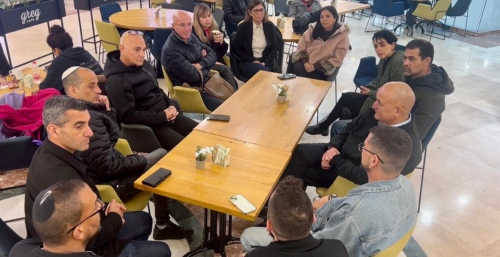
Director General Vaknin and ministry representatives with business owners at the 8 Center Mall in Kiryat Shmona
A similar impression emerged from a conversation held by Director General Vaknin and senior ministry officials with the manager of Rimoni Plast, an essential factory that, according to him, sustained approximately NIS 40 million in damage during the war and is still awaiting compensation, as well as with business owners at the 8 Center mall.
It is midday on a weekday, yet the mall is empty. “I don’t see the light at the end of the tunnel. If the situation doesn’t improve, a year from now half of the stores you see here that are still operating will close,” said the mall’s manager, whose facility was directly hit by three missiles during the war.
“On October 7 I fought in Be’eri and Kfar Aza,” said the owner of a bag shop in the mall. “I served more than 500 days of reserve duty. Then I return home to Kiryat Shmona and discover that we are living in a different world – that I must fight again, this time for my business.”
Another business owner added, “We relied on the kibbutzim in the area and on residents of the Golan Heights,” he said. “But while we were evacuated, they opened shops in Katzrin, where they now have everything; they no longer need us. The mall is helping us by not charging rent, but that isn’t enough. We need to bring high-quality residents here; to offer grants to young people so they will move to the city.”
The sharp decline in business owners’ income across the Galilee is compounded by the difficulty of dealing with damage caused by criminal organizations that demand protection payments. At a meeting between the ministry’s delegation and the head of the Metula Local Council, David Azoulay, leaders of the “Ad Kan” (Hebrew for “no further”) association also took part – an organization founded by farmers and business owners in the Upper Galilee to put an end to the protection-racket phenomenon.
“We set three principles: we don’t pay, we act openly, and we act together,” said Yariv Ben Ami, owner of an agricultural development company. “As a business owner, you have two options: pay protection and keep working or refuse to pay and have your business burned down; and when that happens, the insurance won’t compensate you. We are helping many businesses, but where is the state? Am I supposed to act as the regional sheriff?”
Leaders of the association called for stronger enforcement and harsher penalties, alongside compensation for affected business owners.
“The Government Isn’t Really Helping”
During the meeting, David Azoulay reviewed Metula’s rehabilitation efforts. “We still face many difficulties. In Metula, 28 of 32 public buildings were damaged by Hezbollah fire. About 78% of the homes were damaged, and the rest were damaged by rats and pests. “We decided to carry out a comprehensive renovation of the public buildings so they can function for decades to come. But every such change requires a bureaucratic process that takes about a year. We planned to establish a regional rehabilitation center with ten treatment rooms, but the process has stalled. “Only 80 of 240 hotel rooms have resumed operation. Forty families have come to live here and need transportation to schools, and there is no response. The government isn’t really helping us.”
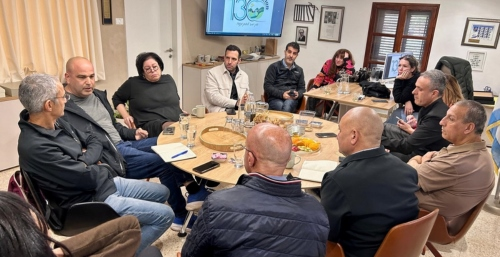
The head of the Metula Local Council and representatives of business owners battling the protection-racket phenomenon meet with the ministry’s delegation
Azoulay accompanied the delegation on a visit to the synagogue, whose renovation is nearing completion: “A missile struck the foyer, causing extensive damage. Torah scrolls were eaten by rats. We renovated the synagogue at a cost of one million shekels.”
According to him, not all services have yet resumed operation. For example, the post office: “The branch is still locked. Instead of a postal worker, two retired residents are volunteering to distribute mail to their neighbors.”
“Our hearts are with you,” Director General Vaknin told residents he met during the visit. “We understand the great pain. You are carrying the north on your shoulders, but this should not be only your mission; it should be the mission of the entire people of Israel.” The Director General emphasized that “we have been accompanying the rehabilitation of the south and the north for a long time, and in the coming weeks we will publish reports on the deficiencies we have found.”