

The Director General of the Office of the State Comptroller and Ombudsman, Brig. Gen. (Res.) Yishai Vaknin, accompanied by senior staff from the office, went on tours to the localities and sites hit by Iranian missiles, to closely track the gaps in the field. A summary of the first week of Operation Rising Lion
The Iranian missile attack poses a challenge the likes of which Israel has never known before. Although during the Gulf War in 1991 surface-to-surface missiles were launched at Israel, some of which caused a lot of damage, but not on the scale recorded during the first days of Operation Rising Lion. The Iranian missiles, each one weighing about half a ton, spread destruction on a very large scale – and during the first week of the war they claimed the lives of dozens of people, injured hundreds and forced thousands of families to evacuate from their homes that had been hit.
From the start of the operation against Iran, the Office of the State Comptroller and Ombudsman prepared for prompt action on site, as it did when the Swords of Iron War broke out.
Simultaneously with the tours conducted during the first week by the State Comptroller and Ombudsman, Matanyahu Englman, in the impacted neighborhoods in Bat Yam, Ramat Gan, Petah Tikva, Herzliya, Holon and the Soroka Hospital in Beer Sheva – the Director General of the Office, Brig. Gen. (Res.) Yishay Vaknin, the directors of the audit divisions, the director of the Office of the Ombudsman and the department directors conducted tours at the sites where the missiles hit, the hospitals and other locations, with the aim of examining the gaps and the needs in the field – and to assist in finding a solution for the specific problems faced by the residents whose homes had been destroyed.
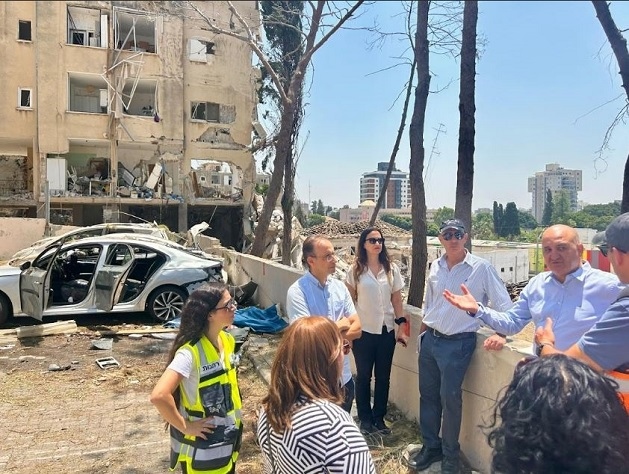
The Director General and his staff near the impacted building in Rehovot
At the same time, Comptroller and Ombudsman Englman instructed the Office of the Ombudsman to renew the operation of the hotline. The Office of the Ombudsman's hotline, available by telephone and WhatsApp, has so far assisted dozens of complainants affected following the state of emergency and who require assistance vis-à-vis the public bodies. The hotline operates from Sunday to Thursday (08:00-17:00) by telephone 02-6665199 and by WhatsApp 050-3995422.
Destruction at the Weizmann Institute
On Tuesday (17.6.2025) a team headed by Director General Vaknin arrived at Rehovot. The tour opened at the Kaplan Hospital. The Hospital Director, Professor Tarif Bader, gave a survey of the activity of the hospital, which so far has treated more than one hundred injured people since the start of Operation Rising Lion, and warned about the substantial protection gaps that must be rectified. It should be noted that the preparation of the audit reports about the protection of hospitals and the protection and sheltering by the local authorities during the Swords of Iron War are presently nearing completion.
The tour continued in a neighborhood in the center of Rehovot that had been hit in the explosion. The Director General of the Municipality, Moshiko Erez, outlined the activity of the Municipality, Property Tax and the various government ministries following the event. It should be noted that audits are currently being conducted on the evacuation and absorption of the population during the Swords of Iron War.
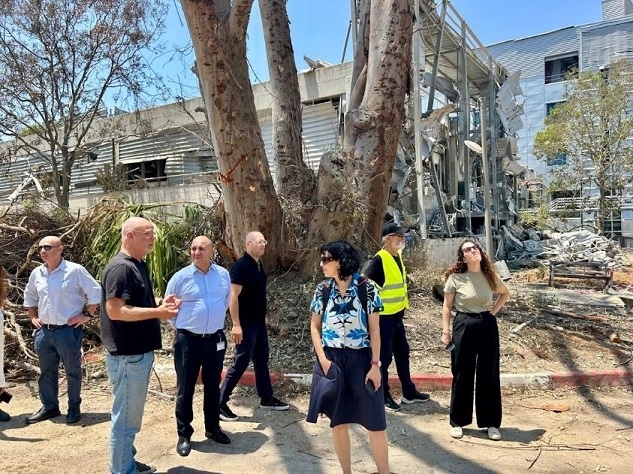
Laboratories and research departments hit. Weizmann Institute
The activity of the Weizmann Institute in Rehovot, one of the world's leading research institutes, suffered a massive hit after an Iranian missile exploded in the Institute's area. Director General Vaknin and his team toured the many buildings that had been hit, including the original laboratory founded by Professor Chaim Weizmann in 1934. It is estimated that it will take several years before the Institute can rebuild laboratories and research departments that had been hit and renew its activity on the same scale as before this week.
The tour concluded at the new headquarters of the Magen David Adom in Ramle. MDA Director General, Eli Bin, and MDA Global President Gilad Erdan, described to Director General Vaknin and his team the activity of the blood bank that supplies blood portions in times of routine and emergency. It should be noted that the audit on the blood bank's activity during the Swords of Iron War is currently being completed.
Medicine in a state of emergency
The following day (18.6.2025) the Director General and his team toured areas that had been hit in Tel Aviv and Bnei Brak as well as at the Ichilov Hospital.
The Iranian missile that hit the heart of Tel Aviv destroyed residential buildings, some of which had been designated for preservation, and about one thousand residents were evacuated from their homes. The Director General of the Municipality, Menachem Leibe, raised issues connected to temporary accommodation, the regulation of powers of action, the evacuation of private shelters and the award of compensation to businesses that had been indirectly affected.
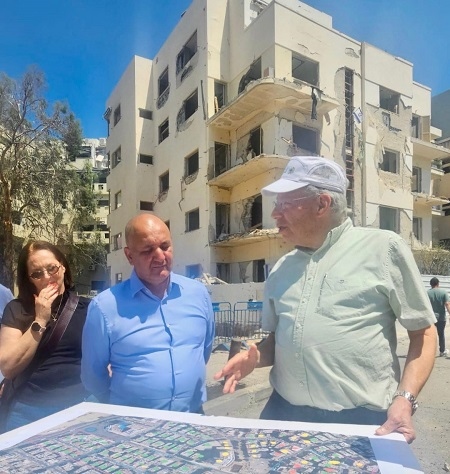
Hundreds of residents have been evacuated. The destruction in the heart of Tel Aviv
Residents who were staying there were exposed to the Office of the Ombudsman's activity so that they would be able to avail themselves of its services.
Another tour was conducted at the Ichilov Hospital. The visit started in the medical center's control room, where the hospital's Director General, Professor Eli Sprecher, together with the senior executive staff, gave a presentation on the center's preparation for a state of emergency, its continuous functioning since the start of the operation against Iran, and the work plans that had been put in place in advance. They presented the complete transition process from the center's activity to activity in the protected areas, including the dilution of the number of patients for the purpose of freeing up beds.
The Director General and his team toured the departments that had been relocated and spread out over the hospital's car parking floors, which had been adapted to full medical functioning under threatening conditions. During the course of the tour, a detailed explanation was given about how all the departments were being operated, the nursing arrays, the protection solutions, the logistical organization and how they were coping with the treatment routine in the hospitals operating under extreme conditions.
The Office of the Ombudsman for the residents
One of the Iranian missiles directly hit a school for special needs children and near another school in Bnei Brak. There were no children at the schools – but a resident living nearby was killed and a great deal of damage was caused. The Municipality's Director General, Israel Ehrenstein, reported to the Director General and his office's staff that about 200 families had been compelled to evacuate the neighborhood and that reports of looting had been received.
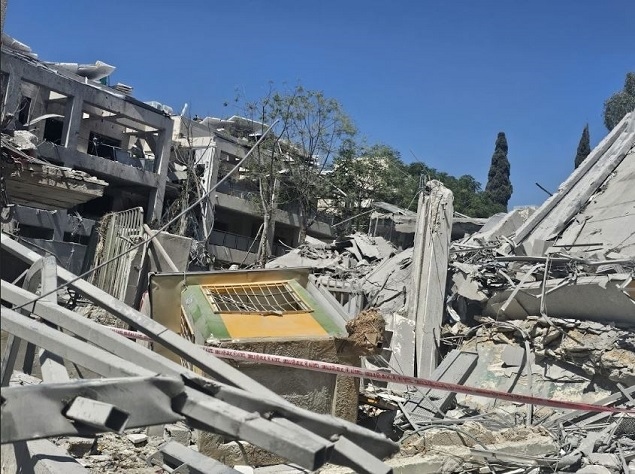
Fear of looting. A neighborhood affected in Bnei Brak
Residents whose homes had been damaged arrived at the scene during the tour. They arrived alone, in order to preserve their few personal belongings that remained, and sat down alongside the walls of the destroyed buildings. The residents approached the Office's Director General and his staff, and painfully shared their stories, against the complex personal background they were coming from and the additional challenge forced upon them following the severe damage to their homes. The staff listened to the residents, wrote down the main points of their stories, and encouraged them to avail themselves of the services of the Office of the Ombudsman, which had been especially reinforced during the present time.
Maternity ward in the parking lot
19 years after the Second Lebanon War, when the Rambam Hospital was exposed to Hezbollah missiles, the situation at the largest medical center in Haifa is completely different. At the start of the operation, the hospital's departments were moved to the floors of the underground parking lot in a complex logistical operation. The Rambam Director, Professor Michael Halbertal, led Director General Vaknin and senior staff from his office (19.6.2025) among the various departments that were operating from the parking lot: From operating rooms and intensive care, through internal and neurosurgical departments, and up to daycare. Partitions had been set in order to separate the various departments and provide the patients with the maximum privacy possible under the exceptional circumstances they had encountered. In the maternity ward, the nurse smilingly said that since the start of the operation and until that morning, 69 babies had come into the world in the department, and when they are grown up they could say that they had been born in the hospital's parking lot.
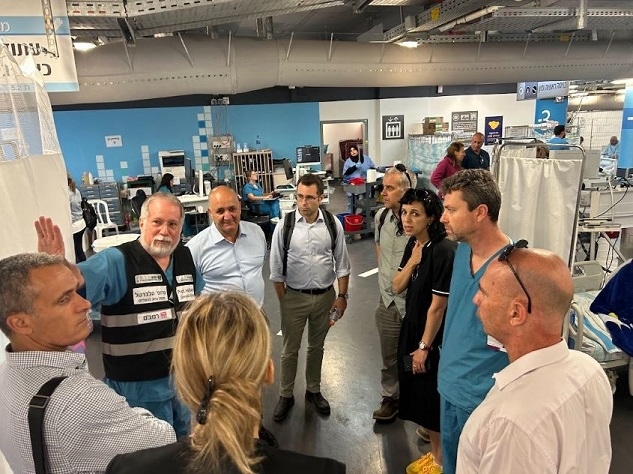
The underground hospital in the Rambam parking lot
Dealing with the challenges
On the screens in the protected municipal operations room at the Haifa Municipality, the Mayor, Yona Yahav, can view focal points in the city and track the response provided for the residents' inquiries. Yahav presented the challenges confronted by the third largest city in Israel, which also houses a large number of facilities of strategic importance. The Municipality's Director General, Gadi Margalit, presented the Director General and his staff with a detailed picture of what was being done in Haifa, and accompanied them on a tour of the street that had suffered a direct hit, one of several hits which occurred at the city.
At the site of the disaster in Tamra
Director General Vaknin, accompanied by additional senior staff from his office, continued from Haifa to pay a condolence visit to Adv. Raja Khatib, who had lost his wife Manar and his two daughters Hala and Shada, after the missile had struck their home in Tamra. Another member of the family, Manar Diab Khatib, was killed in the disaster.
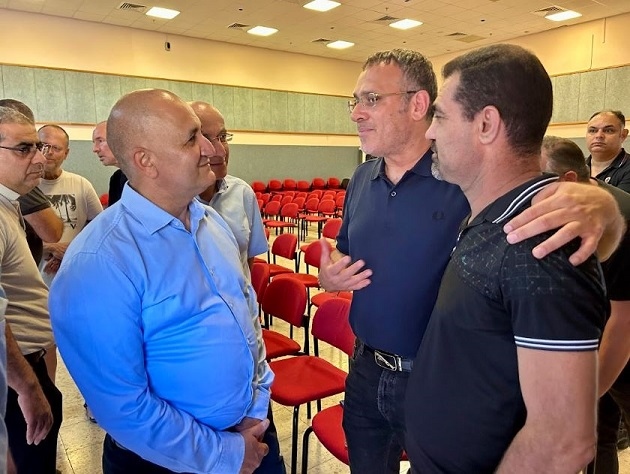
Director General Vaknin and Adv. Khatib (in the center), whose wife and daughters were killed by the missile hit in Tamra
The Director General and his team toured the disaster site and surveyed the damages that had also been caused to neighboring houses.
The Mayor of Tamra, Mussa Abu Rumi, told the staff of the Office of the State Comptroller about the Municipality's organization on the night of the disaster, and the protection gaps in the city, where about 60% of its homes are not protected.